Operational purpose
Door Access + Time Attendance focuses on access-plus-attendance dual use. Applies identity and schedule rules to a controlled opening while recording granted, denied and exception events.
Hikvision access-control systems and combined staff-access/attendance deployment. This page focuses on Brand & Combined System within Door Access / Access Control, with site inputs, interfaces, verification and responsibility kept visible.
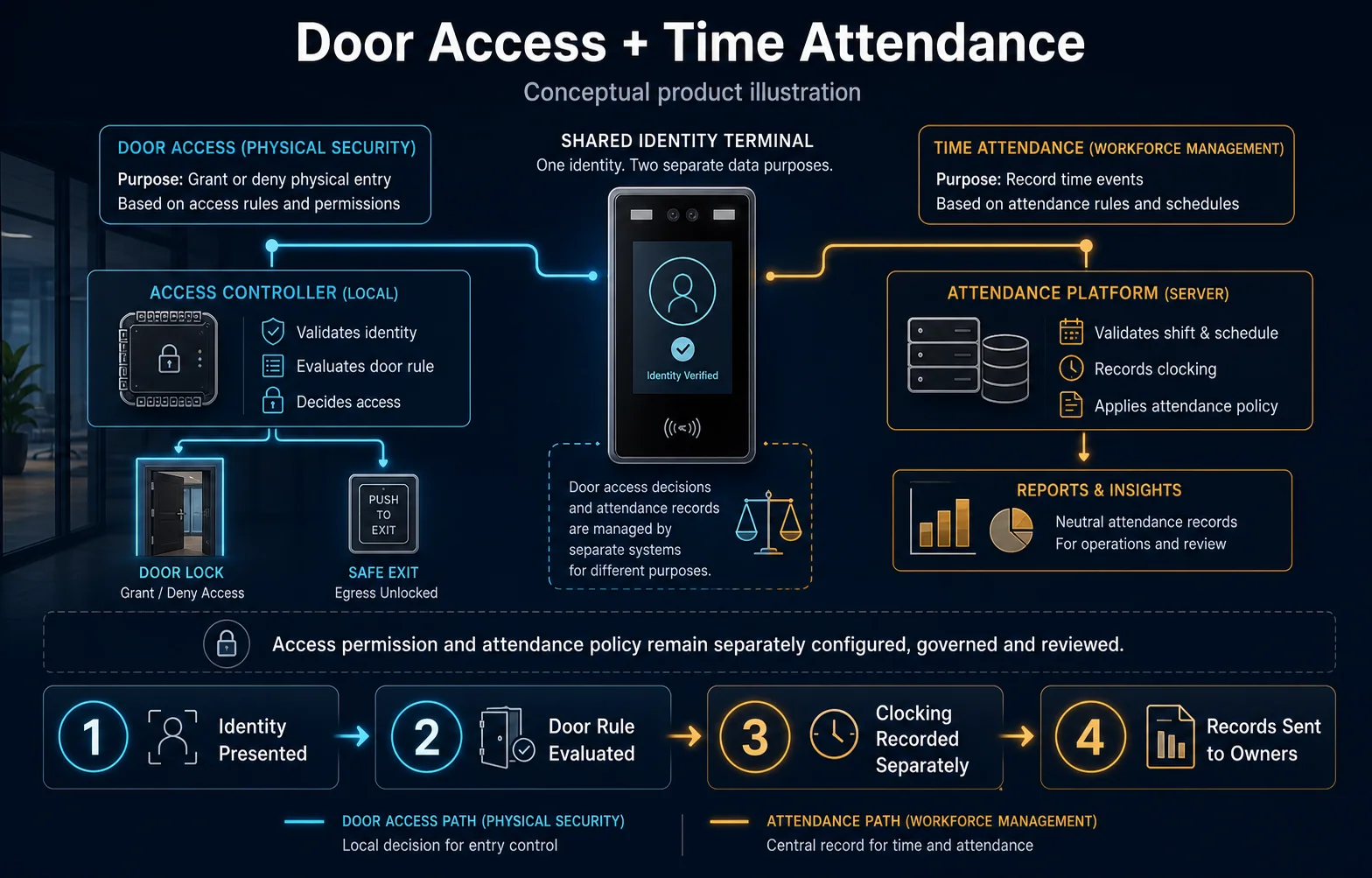
Conceptual Door Access + Time Attendance product and system illustration for Brand & Combined System. Final device form, model, interfaces and quantities are confirmed from the assessed scope and approved product data. Conceptual identity and permission path for Door Access + Time Attendance, derived from this page's scope, interfaces and acceptance record.
Conceptual planning path — not an as-built drawing or project photograph.
Hikvision access-control systems and combined staff-access/attendance deployment.
It sits in Door Access / Access Control under Brand & Combined System. The final deliverable is shaped by the intended outcome, the installed or proposed environment and the interfaces that must be owned, supplied, integrated and tested.
Use this page when Door Access + Time Attendance is the specific system decision, not merely one line inside a wider Door Access / Access Control quotation. Its exact focus is access-plus-attendance dual use. Assessment records door schedule, material and swing, lock, closer, egress and fire-release hardware, user groups, credentials, power and software ownership, access permissions versus HR clocking policy and closes with grant and deny by group and time, forced, held and door-contact events, safe exit, emergency release and administrator handover, door event and independent attendance report. Adjacent Door Access / Access Control options may share infrastructure while requiring different capacity, interfaces, operating rules or evidence, so the selection and handover result remain independently reviewable.
Use these four records to keep Door Access + Time Attendance distinct from adjacent systems or service tasks.
Door Access + Time Attendance focuses on access-plus-attendance dual use. Applies identity and schedule rules to a controlled opening while recording granted, denied and exception events.
For Door Access + Time Attendance, record door schedule, material and swing, lock, closer, egress and fire-release hardware, user groups, credentials, power and software ownership, access permissions versus HR clocking policy; add user groups, credentials, schedules, controlled openings, safe-exit behaviour, privacy ownership and exception handling.
Access control cannot correct an unsafe or unsuitable door; egress, fire-door and emergency-release duties override convenience features. Door, lane, lift or enrolment conditions can invalidate software rules, while emergency release and data-controller duties override convenience.
Accept Door Access + Time Attendance with grant and deny by group and time, forced, held and door-contact events, safe exit, emergency release and administrator handover, door event and independent attendance report; retain granted, denied, expired and emergency scenarios, physical interface state, administrator roles and event-log evidence.
These checkpoints make this page specific to Door Access + Time Attendance rather than a generic keyword page.
Define access-plus-attendance dual use as the operating result for Door Access + Time Attendance, including the users, process and exceptions it must serve.
For Door Access + Time Attendance, confirm door schedule, material and swing, lock, closer, egress and fire-release hardware, user groups, credentials, power and software ownership, access permissions versus HR clocking policy.
Map Identity or request → Authorisation rule → Door, lane or workflow interface → Event & exception record for Door Access + Time Attendance and identify every interface owned by HJ, the customer, ISD supply or an appointed specialist.
Access control cannot correct an unsafe or unsuitable door; egress, fire-door and emergency-release duties override convenience features. Final models, capacities and quantities still follow survey, compatibility and availability.
For Door Access + Time Attendance, record grant and deny by group and time, forced, held and door-contact events, safe exit, emergency release and administrator handover, door event and independent attendance report; also agree authorised and denied transactions, safe release or exception behaviour, event time and operator record before handover.
HJ coordinates assessment, engineering, installation, integration, testing and lifecycle support only for the scope recorded in the quotation. ISD handles catalogue, model, datasheet, supply and availability enquiries. Customer, consultant, builder and appointed-specialist responsibilities remain explicit.
Identity, image, credential and movement data require an authorised controller, lawful access, proportionate collection, retention rules and recorded administrator responsibility.
This focused topic remains connected to its complete system owner. Final models, quantities, interfaces and included work are confirmed in the assessed quotation.
Use these routes to move from this focused record into the complete system, site, capability and aftercare journey.
Use the answers as a planning boundary; site conditions and written scope remain decisive.
Door Access + Time Attendance focuses on access-plus-attendance dual use within Brand & Combined System. Applies identity and schedule rules to a controlled opening while recording granted, denied and exception events. The approved selection must respect this boundary: Access control cannot correct an unsafe or unsuitable door; egress, fire-door and emergency-release duties override convenience features.
Confirm door schedule, material and swing, lock, closer, egress and fire-release hardware, user groups, credentials, power and software ownership, access permissions versus HR clocking policy. Record grant and deny by group and time, forced, held and door-contact events, safe exit, emergency release and administrator handover, door event and independent attendance report, then complete authorised and denied transactions, safe release or exception behaviour, event time and operator record against the approved scope.
No. HJ handles engineering, installation and integration. ISD handles product-family, model, datasheet, supply and availability enquiries separately.
Share the site, intended outcome, existing equipment and timing. HJ will confirm the correct system route, responsibility boundary and next step.