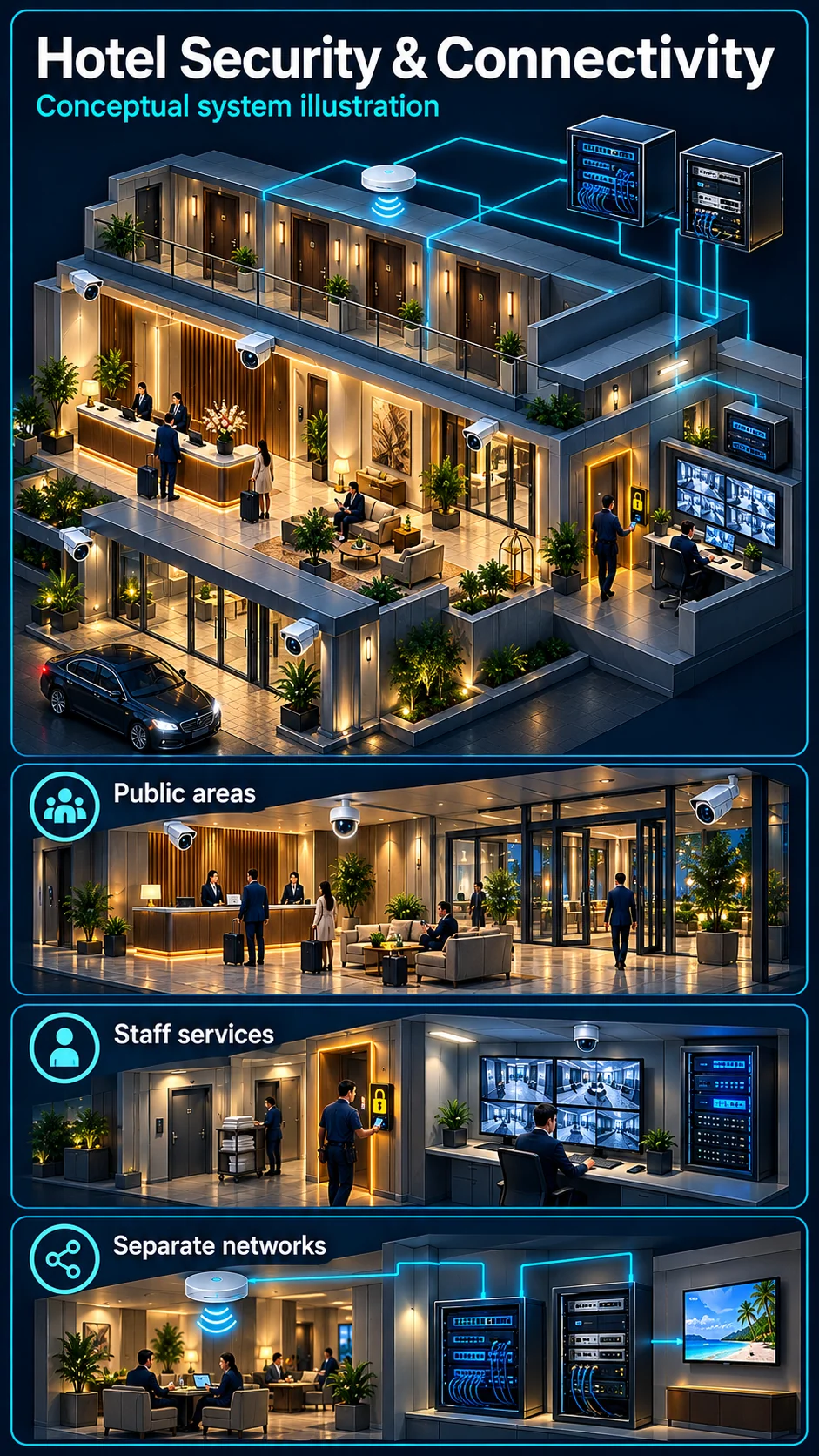
Public arrival and back-of-house areas
Review entrances, lobbies and staff-only approaches with management. Do not treat guest rooms or other sensitive spaces as routine camera locations.
Hotel systems face an audience no other building has: paying guests who review everything. TV that works, WiFi that connects first time, corridors that feel safe — the ELV package is part of the guest experience.

Industry solution
Hotels operate through the night. Security views, staff access, guest internet and television services need coordinated planning while retaining their own privacy, permissions and service boundaries.
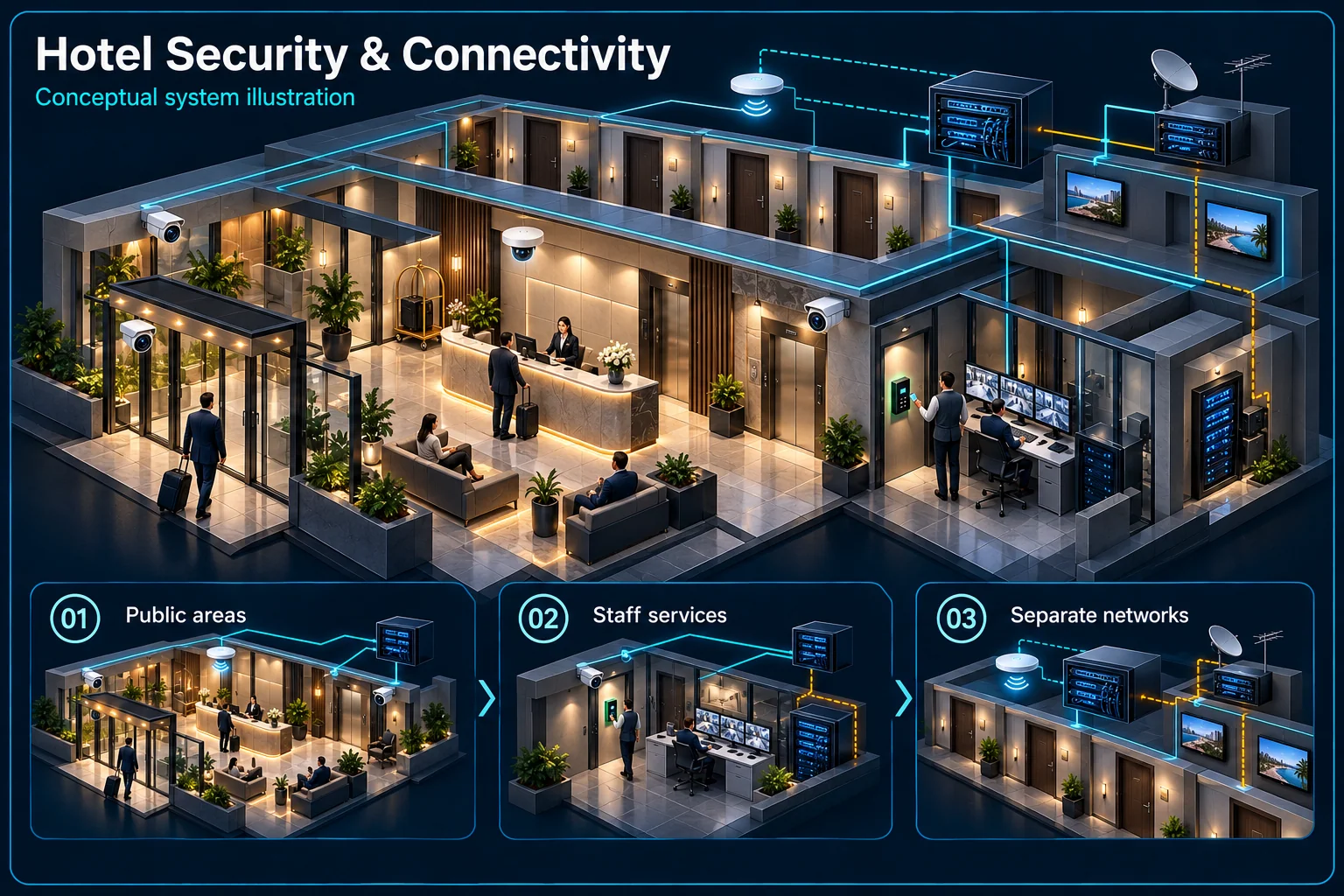
Security supports the duty team while guest connectivity and media remain independently defined services.
Guest arrivals and circulation
Staff permissions
Authorised duty team
Separate network service
Separate media scope
Agree appropriate public-area views and separate staff routes with the operator. Late arrivals and routine service work should not be treated as unusual simply because they happen at night.
Describe which operator verifies a door, loading or service-area event and how it is escalated. Automatic audible warnings are not a default response throughout guest areas.
Wi-Fi coverage, network administration, television distribution and content services need their own acceptance checks. They are not automatically included or controlled by the CCTV platform.
Agree access windows, guest-impact precautions and account ownership before installation. Provide the relevant staff with viewing, playback and fault-reporting instructions for their actual responsibilities.
Night-time movement is normal in a hotel. Any event rule needs an appropriate area, condition and duty-team response rather than a site-wide movement alarm.
Only if explicitly named. Distribution equipment, content rights, subscriptions and operator services remain separate items to confirm.
CCTV scene planning · Hotel & hospitality
Hotel CCTV in Kuching belongs in the wider access, guest Wi-Fi, TV and back-of-house plan, with agreed privacy and operating boundaries.
Review entrances, lobbies and staff-only approaches with management. Do not treat guest rooms or other sensitive spaces as routine camera locations.
Late arrivals, staff shifts and service access remain normal activities. Limit any warning rule to agreed restricted areas and avoid assuming that an audible response suits guest areas.
Agree the operator, record permissions and escalation procedure. Coordinate occupancy, quiet work windows and network or TV changeovers; test the agreed services before each area is handed back.
No. The response must suit the location and hotel procedure. Confirm any supported warning device, its control and the authorised operator before including it.
No blanket guarantee is made. Agree access, work windows, temporary restrictions and rollback or contingency arrangements with the hotel before installation.
The assessed scope, selected equipment and agreed acceptance test determine the final configuration.
The single most-reviewed hotel utility. Coverage gaps on upper floors and connection limits turn into public one-star reviews.
Snowy channels and dead TVs in half the rooms — usually an aging distribution system, not the TVs themselves.
Back-of-house, laundry, kitchen and store need to be off-limits without making the hotel feel locked down.
When something goes missing or an incident is claimed, footage of corridors, lifts and parking decides everything.
Evacuations and urgent notices with no PA reach into guest floors and public areas.
Hotel guests, event visitors and outsiders competing for parking with a guard adjudicating manually.
Hotel systems divide into guest-facing (WiFi, TV, parking) and operational (CCTV, staff access, PA). Both sides need to work — guests review the first set, and incidents test the second.
A guest claims an item disappeared from their room during their stay. Corridor footage shows every entry to that door across the stay window — housekeeping at 10:14, minibar restock at 15:40, the guests themselves otherwise. The claim resolves in one review of footage instead of a police report, a staff accusation and a refund made under pressure. Hotels that have handled this once understand why corridor coverage isn't optional.
Occupied hotels can't shut down — installation runs floor by floor coordinated with housekeeping and front office, guests undisturbed.
Existing coaxial building? SMATV refresh may beat an IPTV rebuild. New wing? Different answer. We recommend by building, not by price tag.
Cabling routes and equipment placement planned so nothing visible cheapens a corridor or lobby.
Hilton Kuching boom gate, barrier gate and autopay parking system. Also Roxy, Jinhole Hotel (SMATV), Amamas / 56 Hotel.
For hotel digital locks, keycards and related room-access product families, see the separate hotel digital-lock catalogue. HJ Security handles the lock installation, encoder and software set-up, programming and handover.
SMATV and IPTV use different distribution and management arrangements. Network-based features such as welcome screens or central content control depend on the selected platform. Review existing cabling, guest requirements, equipment and software before choosing the scope.
Work may be phased around occupancy where the site permits. Agree room access, quiet work windows, temporary service restrictions and acceptance checks with the hotel; zero guest impact is not guaranteed.
Tell us your room count and building age — we'll survey and propose the right stack.
An industry outcome may combine several systems. Use these diagrams to understand each system boundary, then confirm the functions and quantities required for the actual site.

Connects camera capture, transmission, recording, retention, authorised viewing and selected response functions as one commissioned CCTV system.
Planning connection: Choose justified monitoring areas at hotel entrances and shared spaces while respecting guest privacy. Camera coverage and authorised recording should be confirmed separately from guest-room television and Wi-Fi planning.
Open component 01 in the complete Solution →
Defines the shared infrastructure and separate service boundaries for network, WiFi, SIP telephony and TV media distribution.
Planning connection: Define room outlets, television sources and the selected distribution approach with the hotel operator. The headend and endpoint diagram does not establish content rights, subscriptions or compatibility with every room television.
Open component 06 in the complete Solution →
Connects room sources, processing, presentation, conferencing, sound, visual output and operator control.
Planning connection: Plan the agreed hospitality audio areas and operator controls, including separation between spaces with different uses. Room sound and background music must not be presented as a certified emergency voice system.
Open component 06 in the complete Solution →