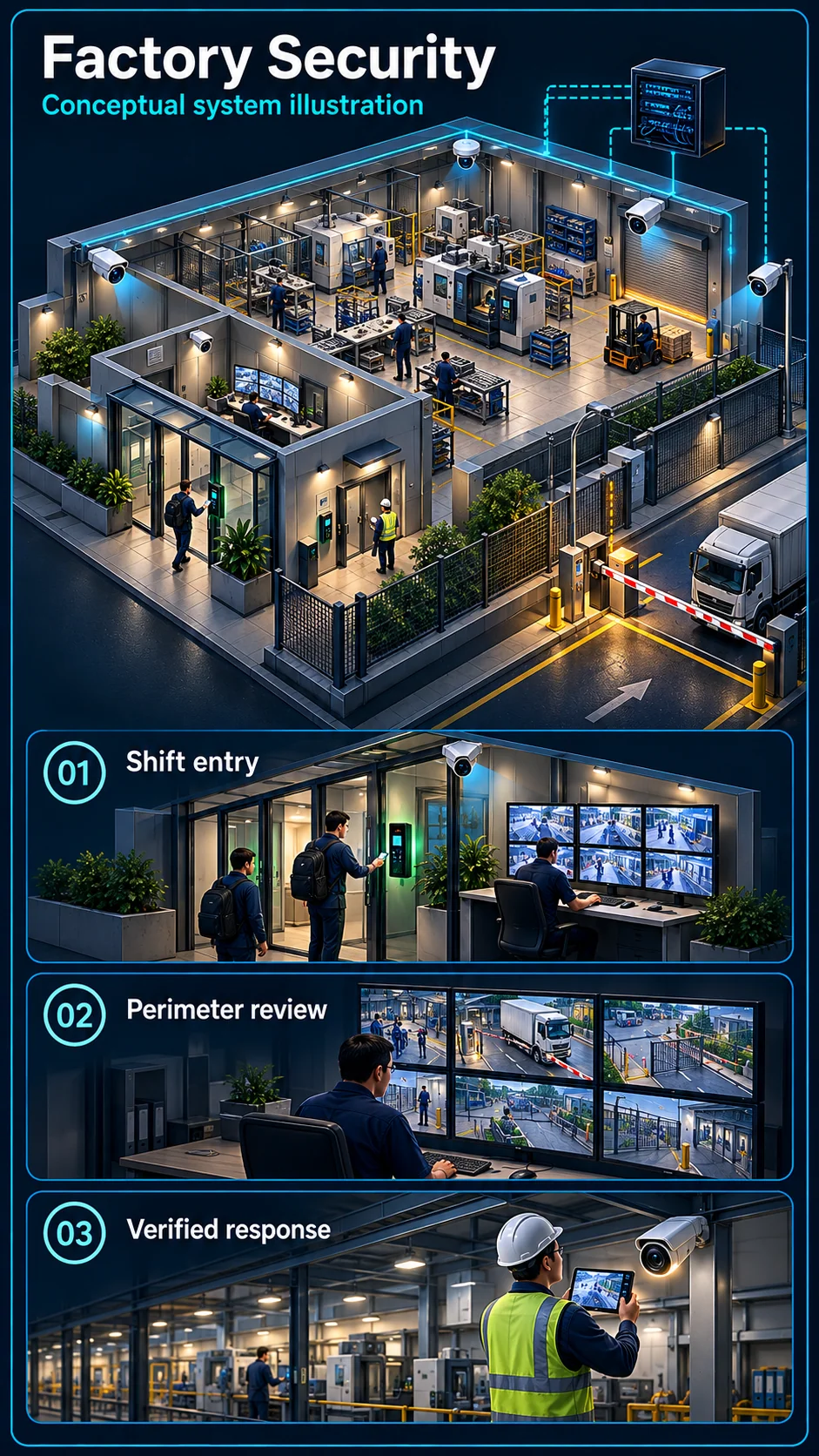
Production, loading and perimeter views
Check racking, moving vehicles, lighting and the actions that need review. Security cameras do not replace machine safeguarding or process-safety controls.
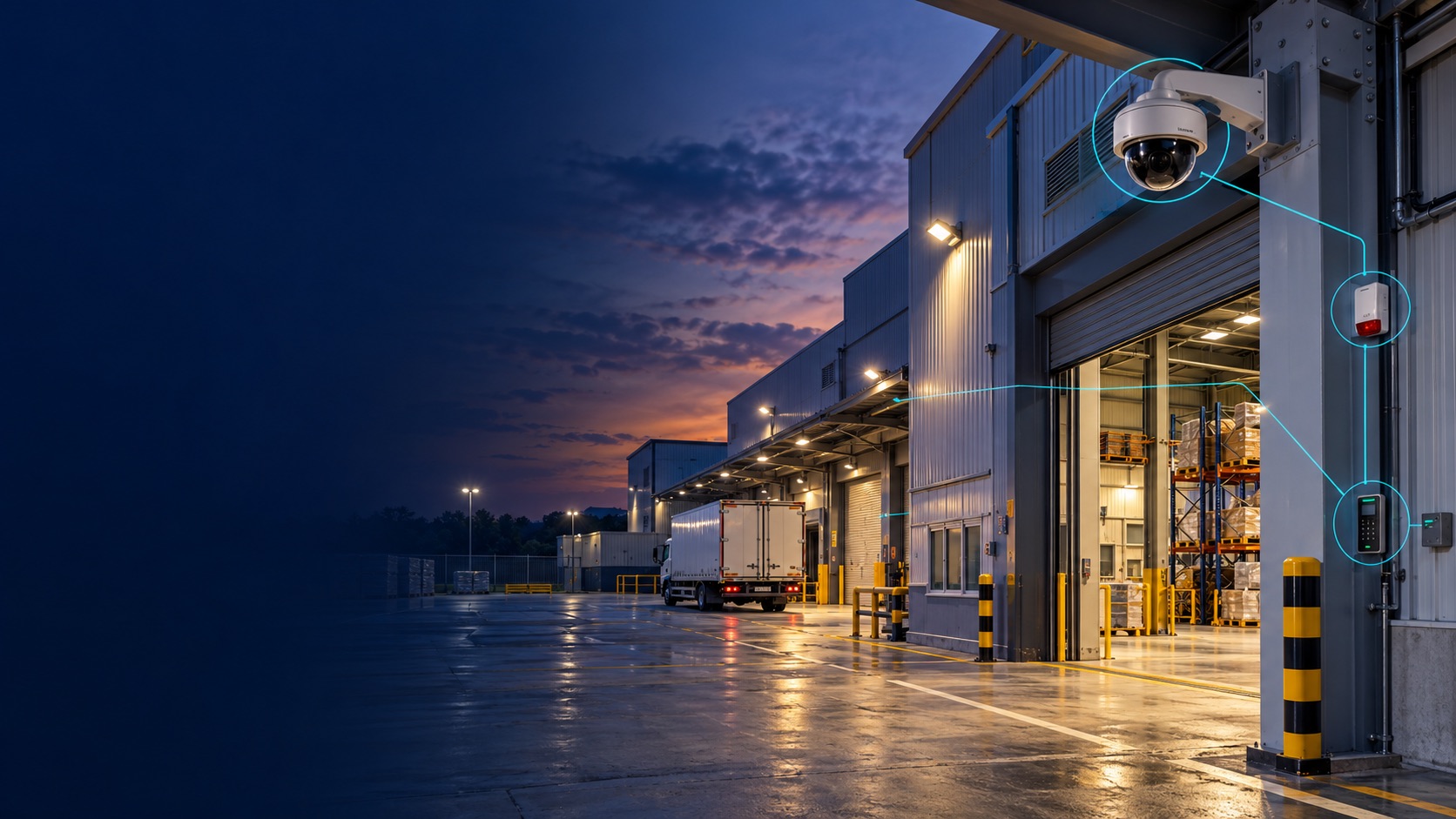
A factory is not an office with bigger rooms — it has high ceilings, vehicle movement, shift changes, process risks and areas where Wi-Fi fails. HJ plans the verified Security, ICT, AV and automation scope together, while regulated LV electrical and fire work is separately assessed and assigned in the approved quotation.

Industry solution
Factory security must work with production, shift changes and contractor activity. Perimeter observation and incident review remain separate from machinery protection and industrial safety controls.
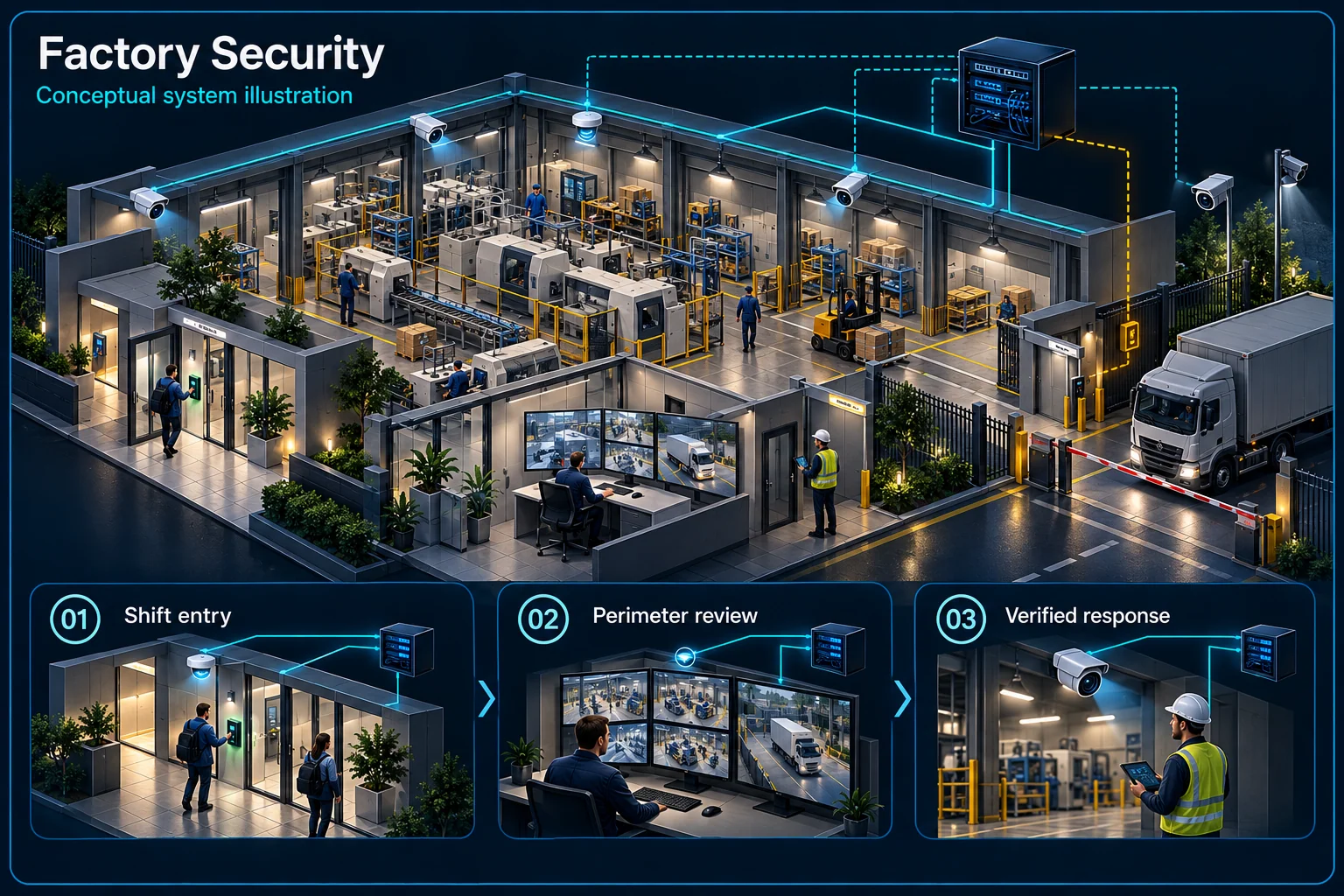
The site plan separates people, vehicles and restricted work rather than using a single blanket perimeter rule.
Vehicle route
Shift movement
Independent safety systems
Permit and time window
Map the normal truck and staff routes before choosing views and rules. Confirm lighting, obstructions and authorised shift movement rather than treating every night-time person as an intruder.
Agree permission windows for contractors and maintenance teams. A warning should have a named recipient and a verification procedure appropriate to the operating risk.
Cameras can support review of an area. They do not replace guards, machinery interlocks or safety procedures, and a CCTV event must not be assumed to stop equipment.
Check views with actual vehicle movement, lighting and operational obstructions. Handover records should identify the shift contact and the permitted response, not just a successful daytime image.
That is not assumed in a security scope. Any machine-control or safety function needs its own competent design, approval and acceptance process.
Shift change introduces legitimate people and vehicles. Testing that activity helps distinguish useful rules from settings that repeatedly interrupt normal work.
CCTV scene planning · Factory & industrial
Factory CCTV in Kuching and Sarawak should support agreed observation and review tasks alongside the production, access and network brief.
Check racking, moving vehicles, lighting and the actions that need review. Security cameras do not replace machine safeguarding or process-safety controls.
Separate normal worker and forklift movement from agreed restricted areas. Define shift, maintenance and closed-site modes with the factory team before selecting warning rules.
Name the person who verifies an event and the approved response. Agree work permits, safe cable routes, production windows and a joint test; no equipment shutdown or alarm linkage is assumed.
That is not a default security-camera function. Any process or safety interface needs separate engineering responsibility, approved design and validation by the responsible parties.
Test normal arrivals, forklift routes, authorised maintenance access and the closed-site condition. Confirm who changes the mode and restores it, alongside recording and response checks.
The assessed scope, selected equipment and agreed acceptance test determine the final configuration.
Standard camera layouts fail in factories — tall racking, machinery and vehicle movement create shadows a survey must map, not guess.
Most factory losses happen where goods move: loading bays, store rooms and scrap areas — precisely where coverage and access logs matter most.
Hundreds of workers clocking in within minutes — paper cards and buddy-punching cost real payroll money every month.
Metal structures and machinery kill signal. Scanners, tablets and IoT sensors drop offline exactly where production needs them.
A fence line without detection is decoration. Night intrusion targets scrap metal, copper cable and parked vehicles.
Maintenance contractors and lorry drivers wandering into production or store areas with nobody able to say who went where.
The final scope depends on the production layout, headcount, operational risks and existing infrastructure. This matrix shows how HJ organises a factory solution without treating every listed system as automatically included. For utility compounds and gas facilities, see the power substation and industrial gas plant solutions.
A perimeter fence zone triggers. The alarm panel identifies which zone; the linked camera preset pulls up that fence section on the guardhouse monitor and your phone; the event is logged with video attached. If it's a false trigger from a monitor lizard, you see that in ten seconds. If it's not, you're calling the police with a live picture instead of driving there blind. That linkage — fence to alarm to camera to phone — only works when the systems are designed together.
A focused package: CCTV on entry, store and work areas, basic alarm, one attendance terminal — sized to protect without over-building.
Zoned access control, shift-grade attendance, floor-wide WiFi, perimeter alarm and structured coverage across production and storage.
Fiber backbone between blocks, electric fence perimeter, command centre monitoring and phased installation planned around production schedules.
Linde Gas — four towns. Perimeter fence note: Sarawak electric fence. Product ecosystem references: Hikvision, JVA and ANPR / parking supply catalogues; HJ Security remains the local installation and commissioning team.
Tell us your factory size, headcount and what's been going wrong — we'll survey and design the whole package.
An industry outcome may combine several systems. Use these diagrams to understand each system boundary, then confirm the functions and quantities required for the actual site.

Connects camera capture, transmission, recording, retention, authorised viewing and selected response functions as one commissioned CCTV system.
Planning connection: Review production access, loading areas and agreed perimeter views with the factory team. Camera positions and recording needs depend on lighting, obstructions and vehicle movement; a generic capture diagram is not a coverage guarantee.
Open component 01 in the complete Solution →
Connects credentials, readers or terminals, permissions, door hardware, safe release and related identity workflows.
Planning connection: Identify which staff, contractor and restricted-area entries require controlled access. Record permission ownership and door-hardware interfaces without treating a reader alone as the complete access system.
Open component 02 in the complete Solution →
Defines the shared infrastructure and separate service boundaries for network, WiFi, SIP telephony and TV media distribution.
Planning connection: Plan backbone and field connection points around the factory's operational layout. Confirm the proposed route, installation environment and responsibility for connecting production-area systems before finalising quantities.
Open component 01 in the complete Solution →
Connects checkpoints, patrol capture, routes, exceptions, reports and selected multi-site supervision.
Planning connection: Agree the patrol locations and route with site operations, then define how visits and exceptions are reviewed. A checkpoint record is a visit record, not proof that every safety or security condition was inspected.
Open component 01 in the complete Solution →