Directional wireless bridge between buildings – Wi-Fi Bridge in Kuching & Sarawak (illustration)

Wi-Fi Bridge in Kuching & Sarawak

Carry network traffic between locations where a practical cable route is unavailable. HJ confirms the supported bridge arrangement, sight path, power and traffic needs; a bridge does not automatically provide user Wi-Fi at the far end.

System selection and integration guideWi-Fi
Wireless BridgeWi-Fi Bridge
Wi-Fi Bridge system diagram
  1. 01Wi-Fi Bridge
  2. 02Radio path, power and resilience
  3. 03Distribution edge
  4. 04coverage-walk samples
Conceptual Wi-Fi Bridge product and system illustration.
Illustration & scope boundary

Conceptual Wi-Fi Bridge product and system illustration for Wireless Bridge. Final device form, model, interfaces and quantities are confirmed from the assessed scope and approved product data. Conceptual transport and endpoint path for Wi-Fi Bridge, derived from this page's scope, interfaces and acceptance record.

Conceptual planning path — not an as-built drawing or project photograph.

What Wi-Fi Bridge covers

Carry network traffic between locations where a practical cable route is unavailable. HJ confirms the supported bridge arrangement, sight path, power and traffic needs; a bridge does not automatically provide user Wi-Fi at the far end.

It sits in Wi-Fi under Wireless Bridge. The final deliverable is shaped by the intended outcome, the installed or proposed environment and the interfaces that must be owned, supplied, integrated and tested.

When to use this page

Carry network traffic between locations where a practical cable route is unavailable. HJ confirms the supported bridge arrangement, sight path, power and traffic needs; a bridge does not automatically provide user Wi-Fi at the far end. Confirm whether the requirement is point-to-point or multiple remote sites, the supported radio family, path survey, equipment access, local network ports and any separate far-end access point.

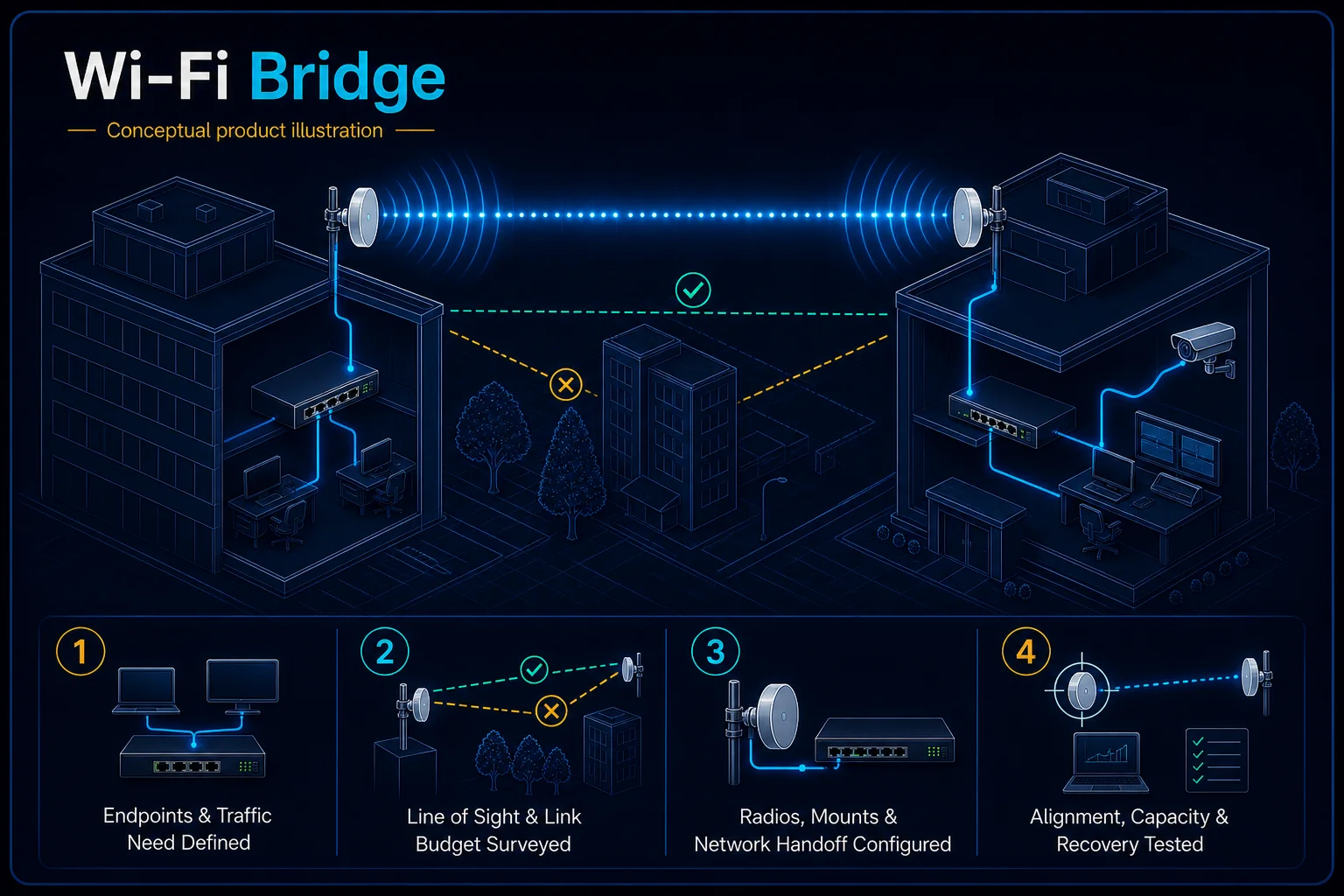
Typical environments to assess

  • Separated buildings with a surveyed radio path
  • Warehouse and control-room links
  • Remote sites with local power and network access
  • Multiple endpoints within a compatible sector design

Engineering SOP & Handover Checklist

From the initial brief to the handover record: what to prepare, check and confirm with HJ.

01

Operational Purpose & Workflow

Define Wireless Bridge as the operating result for Wi-Fi Bridge, including the users, process and exceptions it must serve.

Carry network traffic between locations where a practical cable route is unavailable. HJ confirms the supported bridge arrangement, sight path, power and traffic needs; a bridge does not automatically provide user Wi-Fi at the far end.

02

Pre-Attendance Evidence

For Wi-Fi Bridge, confirm scaled floor plan and materials, concurrent users, devices and applications, RF, uplink, VLAN, guest and controller ownership.

Confirm whether the requirement is point-to-point or multiple remote sites, the supported radio family, path survey, equipment access, local network ports and any separate far-end access point.

03

Diagnostic & Testing Path

Map Source & uplink → Core transport → Distribution edge → Managed endpoint for Wi-Fi Bridge and identify every interface owned by HJ, the customer, ISD supply or an appointed specialist.

04

System & Responsibility Boundary

Wi-Fi speed is bounded by RF conditions, client capability, contention, backhaul and ISP service; signal bars alone are not acceptance. Final models, capacities and quantities still follow survey, compatibility and availability.

Obstructions, interference, shared capacity and upstream faults can limit a radio link. A bridge is not an ISP subscription, guaranteed bandwidth or automatic end-user Wi-Fi.

05

Acceptance & Handover Record

For Wi-Fi Bridge, record coverage-walk samples, throughput at agreed locations, roaming, segmentation and controller record; also agree link, throughput or power test, addressing and segmentation record, label, route and handover schedule before handover.

Record alignment and link status, then verify the agreed end-to-end traffic path and representative capacity. Label both endpoints and retain authorised settings.

Engineering Scope, Regulatory & Service Boundaries

Responsibility and evidence boundary

HJ coordinates assessment, engineering, installation, integration, testing and lifecycle support only for the scope recorded in the quotation. ISD handles catalogue, model, datasheet, supply and availability enquiries. Customer, consultant, builder and appointed-specialist responsibilities remain explicit.

Final scope, quantities, compatibility, access, programme, availability and responsibility are confirmed during assessment and quotation.

This focused topic remains connected to its complete system owner. Final models, quantities, interfaces and included work are confirmed in the assessed quotation.

Questions before proceeding

Use the answers as a planning boundary; site conditions and written scope remain decisive.

What should be confirmed for Wi-Fi Bridge?

Confirm whether the requirement is point-to-point or multiple remote sites, the supported radio family, path survey, equipment access, local network ports and any separate far-end access point.

What are the limits of this scope?

Obstructions, interference, shared capacity and upstream faults can limit a radio link. A bridge is not an ISP subscription, guaranteed bandwidth or automatic end-user Wi-Fi.

What should be checked before handover?

Record alignment and link status, then verify the agreed end-to-end traffic path and representative capacity. Label both endpoints and retain authorised settings.

Planning Wi-Fi Bridge? Tell HJ about your site

Tell us where it will be used, what it needs to do and what equipment you already have. HJ will recommend the right system, explain who is responsible for what, and agree the next step with you.