Operational purpose
KNX Troubleshooting in Kuching uses the troubleshooting workflow for KNX fault isolation. Diagnoses KNX bus, device, group-address and sequence faults using the controlled ETS project as the configuration source.
Lighting, curtain, HVAC, device replacement and system commissioning. This page focuses on Building Automation within KNX Service, with site inputs, interfaces, verification and responsibility kept visible.
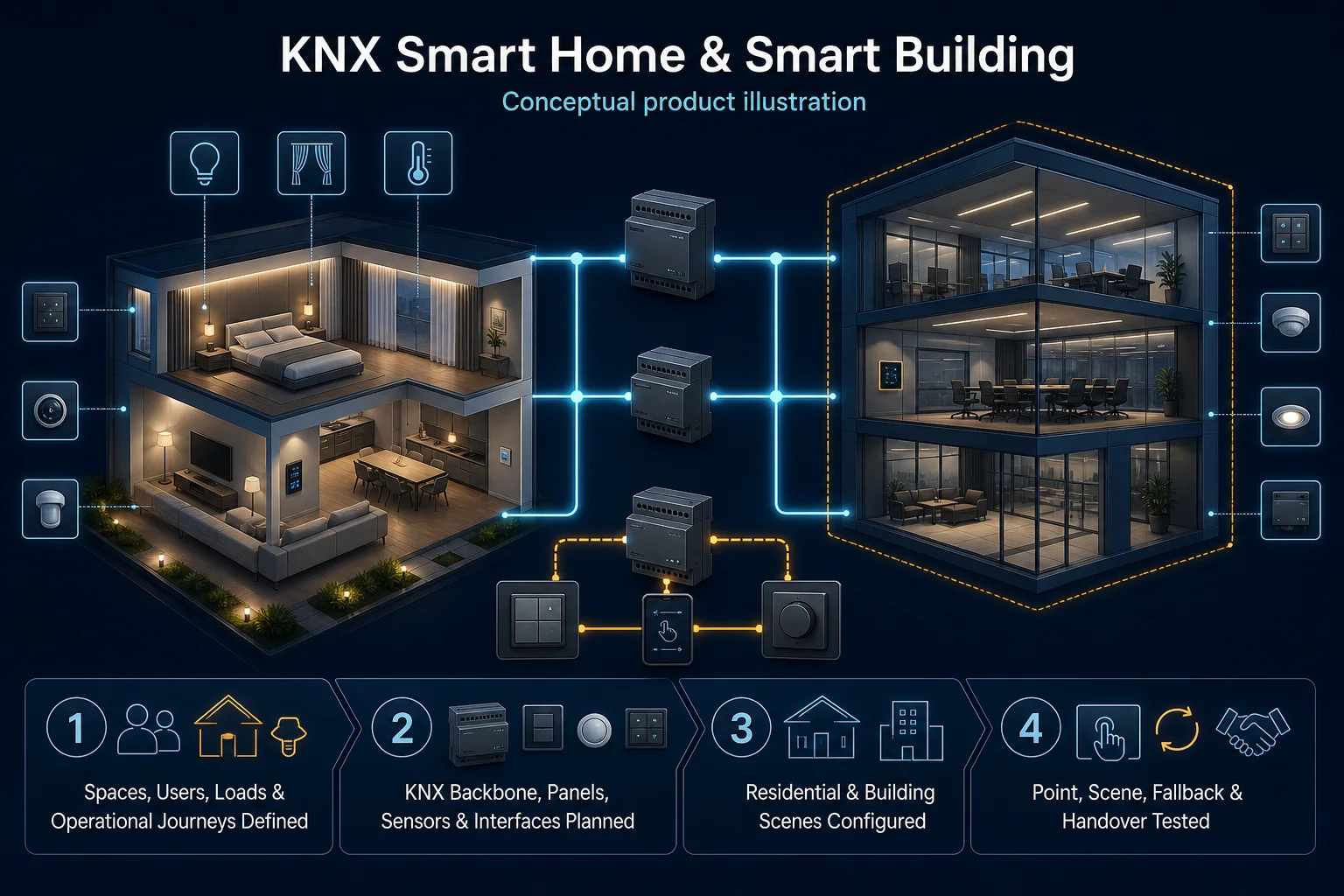
Conceptual planning path — not an as-built drawing or project photograph.
Lighting, curtain, HVAC, device replacement and system commissioning.
It sits in KNX Service under Building Automation. The final deliverable is shaped by the intended outcome, the installed or proposed environment and the interfaces that must be owned, supplied, integrated and tested.
Use KNX Troubleshooting in Kuching when the installed system needs a troubleshooting workflow focused on KNX fault isolation, rather than a generic call-out. The work record checks ETS project, version and authority, topology, line and power-supply details, affected addresses, programming history and gateways, bus voltage, telegrams, addresses and affected functions, applies reported symptom and occurrence pattern → power, cabling, network, field-device and configuration isolation → root-cause evidence → corrective action and re-test, and closes with bus and topology health, individual and group-address tests, scene, priority, gateway and ETS change record, reproduced fault, root cause and restored group function. This separates KNX Troubleshooting in Kuching from other KNX Service tasks that may touch the same equipment but require a different method and close-out record.
Use these four records to keep KNX Troubleshooting in Kuching distinct from adjacent systems or service tasks.
KNX Troubleshooting in Kuching uses the troubleshooting workflow for KNX fault isolation. Diagnoses KNX bus, device, group-address and sequence faults using the controlled ETS project as the configuration source.
For KNX Troubleshooting in Kuching, record ETS project, version and authority, topology, line and power-supply details, affected addresses, programming history and gateways, bus voltage, telegrams, addresses and affected functions; add point lists, controlled loads or plant, protocols, scenes or sequences, accounts, source files, manual fallback and operator roles.
Without an accurate ETS file, safe changes may require reconstruction; KNX work cannot assume responsibility for HVAC or electrical plant. Cloud lifecycle, missing source files, incompatible field devices and unowned plant can make dashboard control misleading or unsafe.
Follow reported symptom and occurrence pattern → power, cabling, network, field-device and configuration isolation → root-cause evidence → corrective action and re-test and close with bus and topology health, individual and group-address tests, scene, priority, gateway and ETS change record, reproduced fault, root cause and restored group function; retain point-to-point results, scenes or sequences, alarm and trend behaviour, priority and fallback tests, backups and operator handover.
These checkpoints make this page specific to KNX Troubleshooting in Kuching rather than a generic keyword page.
KNX Troubleshooting in Kuching focuses on KNX fault isolation and follows reported symptom and occurrence pattern → power, cabling, network, field-device and configuration isolation → root-cause evidence → corrective action and re-test. Reproduces, isolates and measures a reported symptom until the most defensible root-cause boundary is established.
For KNX Troubleshooting in Kuching, provide the reported symptom or objective, site contact, recent changes and ETS project, version and authority, topology, line and power-supply details, affected addresses, programming history and gateways, bus voltage, telegrams, addresses and affected functions.
Trace Sensor, meter or command → Control & integration logic → Field interface → Dashboard, trend & handover for KNX Troubleshooting in Kuching without assuming the visible symptom identifies the root cause.
Without an accurate ETS file, safe changes may require reconstruction; KNX work cannot assume responsibility for HVAC or electrical plant. Repair, replacement, firmware, programming and parts remain subject to authority, compatibility, warranty, access and serviceability.
Close KNX Troubleshooting in Kuching with bus and topology health, individual and group-address tests, scene, priority, gateway and ETS change record, reproduced fault, root cause and restored group function; record point-to-point function test, scene, schedule, trend or alarm test, backup, export and operator handover and list every restored, deferred and excluded item.
HJ coordinates assessment, engineering, installation, integration, testing and lifecycle support only for the scope recorded in the quotation. ISD handles catalogue, model, datasheet, supply and availability enquiries. Customer, consultant, builder and appointed-specialist responsibilities remain explicit.
Final scope, quantities, compatibility, access, programme, availability and responsibility are confirmed during assessment and quotation.
The applicable regulated scope, competent or appointed persons, approvals, exclusions and records are confirmed before work is accepted.
Use these routes to move from this focused record into the complete system, site, capability and aftercare journey.
Use the answers as a planning boundary; site conditions and written scope remain decisive.
For this Building Automation task, share the symptom or objective, recent changes, authorised access and ETS project, version and authority, topology, line and power-supply details, affected addresses, programming history and gateways, bus voltage, telegrams, addresses and affected functions.
Without an accurate ETS file, safe changes may require reconstruction; KNX work cannot assume responsibility for HVAC or electrical plant. HJ confirms the practical corrective route only after inspection or diagnosis.
The close-out records bus and topology health, individual and group-address tests, scene, priority, gateway and ETS change record, reproduced fault, root cause and restored group function, plus restored items, outstanding faults, approved changes and exclusions.
Share the site, intended outcome, existing equipment and timing. HJ will confirm the correct system route, responsibility boundary and next step.