Operational purpose
Network Upgrade focuses on Network Equipment. Carries segmented data and PoE services through labelled copper, switching, routing and security boundaries.
Core, distribution and access networking with monitoring and security. This page focuses on Network Equipment within Networking, with site inputs, interfaces, verification and responsibility kept visible.
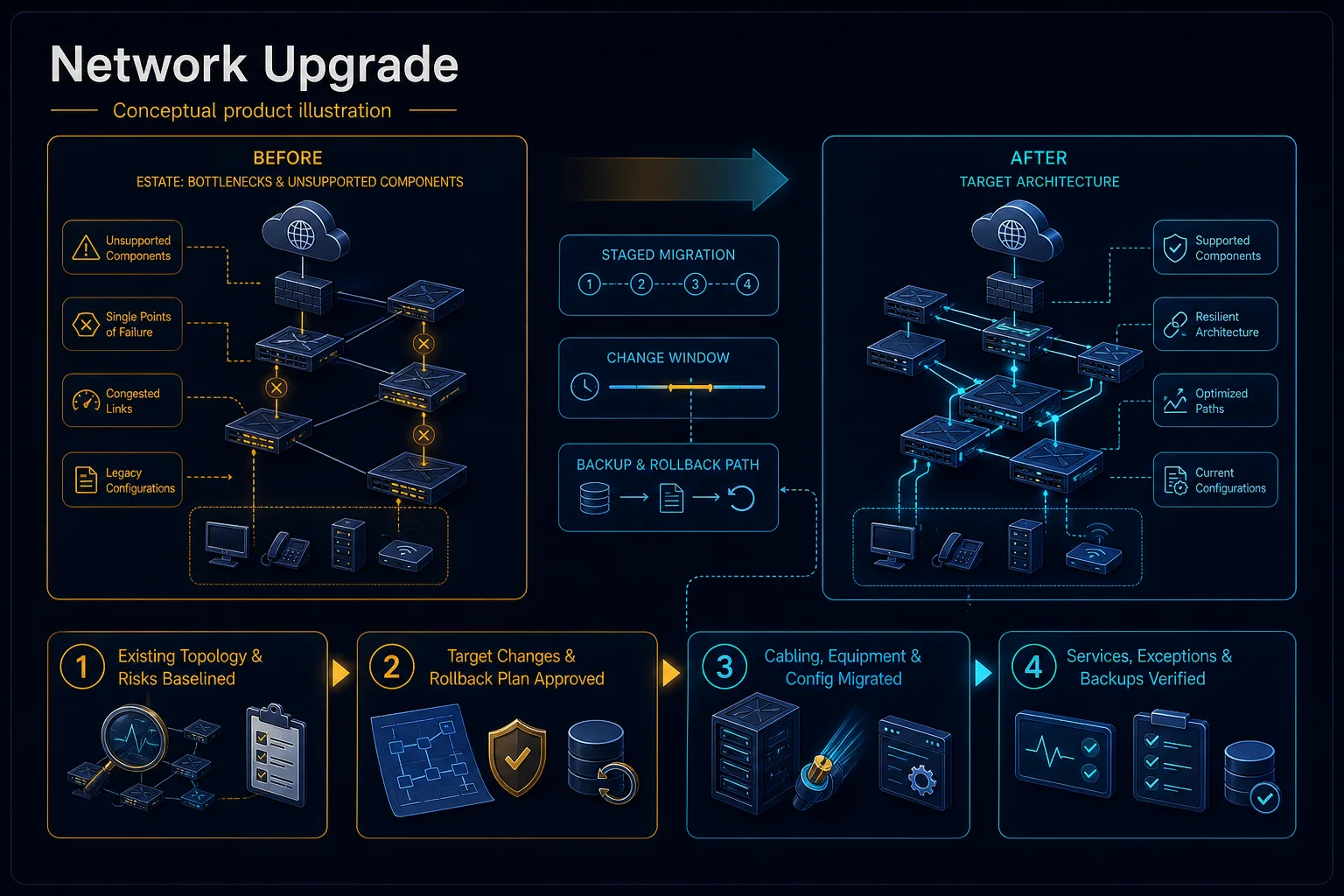
Conceptual Network Upgrade product and system illustration for Network Equipment. Final device form, model, interfaces and quantities are confirmed from the assessed scope and approved product data. Conceptual transport and endpoint path for Network Upgrade, derived from this page's scope, interfaces and acceptance record.
Conceptual planning path — not an as-built drawing or project photograph.
Core, distribution and access networking with monitoring and security.
It sits in Networking under Network Equipment. The final deliverable is shaped by the intended outcome, the installed or proposed environment and the interfaces that must be owned, supplied, integrated and tested.
Use this page when Network Upgrade is the specific system decision, not merely one line inside a wider Networking quotation. Its exact focus is Network Equipment. Assessment records endpoint, outlet and bandwidth schedule, PoE classes and power budget, VLAN, IP, rack, uplink, credentials and change window and closes with copper and link tests, PoE, uplink, VLAN, route, DHCP and DNS checks, configuration backup, labels and port schedule. Adjacent Networking options may share infrastructure while requiring different capacity, interfaces, operating rules or evidence, so the selection and handover result remain independently reviewable.
Use these four records to keep Network Upgrade distinct from adjacent systems or service tasks.
Network Upgrade focuses on Network Equipment. Carries segmented data and PoE services through labelled copper, switching, routing and security boundaries.
For Network Upgrade, record endpoint, outlet and bandwidth schedule, PoE classes and power budget, VLAN, IP, rack, uplink, credentials and change window; add topology, capacity, routes, optical or copper budget, PoE, addressing, segmentation, credentials and outage ownership.
Changes require approved addressing, cybersecurity ownership and outage windows; cabling certification does not prove application performance. Carrier, RF, cabling, switching, routing and application performance are different domains and cannot be accepted from a single online indicator.
Accept Network Upgrade with copper and link tests, PoE, uplink, VLAN, route, DHCP and DNS checks, configuration backup, labels and port schedule; retain link or optical results, coverage or throughput samples, configuration backup, labels, port or core schedules and demarcation records.
These checkpoints make this page specific to Network Upgrade rather than a generic keyword page.
Define Network Equipment as the operating result for Network Upgrade, including the users, process and exceptions it must serve.
For Network Upgrade, confirm endpoint, outlet and bandwidth schedule, PoE classes and power budget, VLAN, IP, rack, uplink, credentials and change window.
Map Source & uplink → Core transport → Distribution edge → Managed endpoint for Network Upgrade and identify every interface owned by HJ, the customer, ISD supply or an appointed specialist.
Changes require approved addressing, cybersecurity ownership and outage windows; cabling certification does not prove application performance. Final models, capacities and quantities still follow survey, compatibility and availability.
For Network Upgrade, record copper and link tests, PoE, uplink, VLAN, route, DHCP and DNS checks, configuration backup, labels and port schedule; also agree link, throughput or power test, addressing and segmentation record, label, route and handover schedule before handover.
HJ coordinates assessment, engineering, installation, integration, testing and lifecycle support only for the scope recorded in the quotation. ISD handles catalogue, model, datasheet, supply and availability enquiries. Customer, consultant, builder and appointed-specialist responsibilities remain explicit.
Final scope, quantities, compatibility, access, programme, availability and responsibility are confirmed during assessment and quotation.
This focused topic remains connected to its complete system owner. Final models, quantities, interfaces and included work are confirmed in the assessed quotation.
Use these routes to move from this focused record into the complete system, site, capability and aftercare journey.
Use the answers as a planning boundary; site conditions and written scope remain decisive.
Network Upgrade focuses on Network Equipment within Network Equipment. Carries segmented data and PoE services through labelled copper, switching, routing and security boundaries. The approved selection must respect this boundary: Changes require approved addressing, cybersecurity ownership and outage windows; cabling certification does not prove application performance.
Confirm endpoint, outlet and bandwidth schedule, PoE classes and power budget, VLAN, IP, rack, uplink, credentials and change window. Record copper and link tests, PoE, uplink, VLAN, route, DHCP and DNS checks, configuration backup, labels and port schedule, then complete link, throughput or power test, addressing and segmentation record, label, route and handover schedule against the approved scope.
No. HJ handles engineering, installation and integration. ISD handles product-family, model, datasheet, supply and availability enquiries separately.
Share the site, intended outcome, existing equipment and timing. HJ will confirm the correct system route, responsibility boundary and next step.