Operational purpose
Fiber Optic Project in Sarawak focuses on point-to-point optical backbone. Delivers measured single-mode or multimode backbone paths with controlled routes, splices, terminations and optical records.
Single/multimode backbone, splicing, termination, patch panels, distribution boxes, SFP/converters, OTDR/power testing, repair, underground and building-to-building fiber. This page focuses on Engineering Package within ELV & ICT Infrastructure, with site inputs, interfaces, verification and responsibility kept visible.
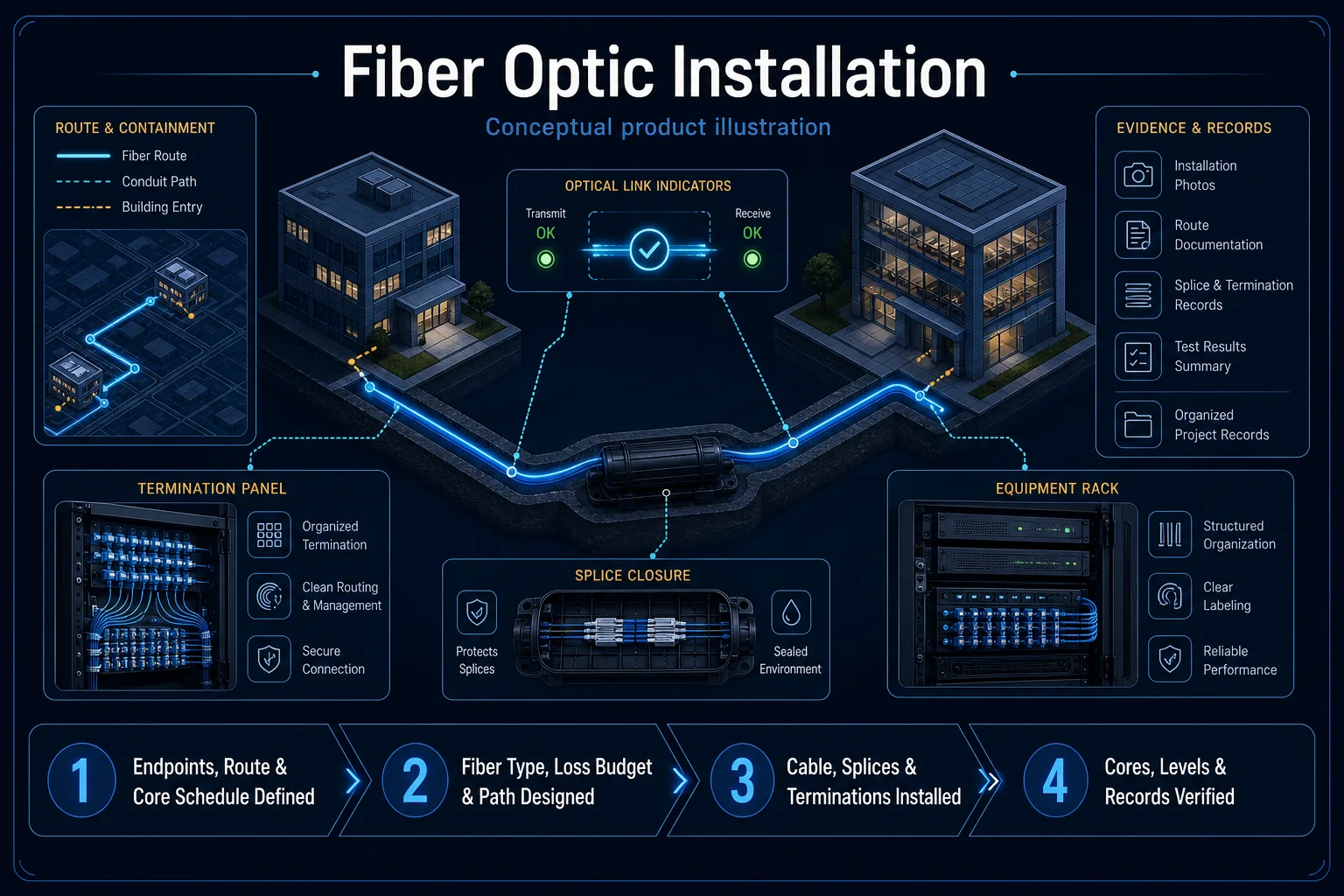
Conceptual planning path — not an as-built drawing or project photograph.
Single/multimode backbone, splicing, termination, patch panels, distribution boxes, SFP/converters, OTDR/power testing, repair, underground and building-to-building fiber.
It sits in ELV & ICT Infrastructure under Engineering Package. The final deliverable is shaped by the intended outcome, the installed or proposed environment and the interfaces that must be owned, supplied, integrated and tested.
Use Fiber Optic Project in Sarawak when the proposed brief needs point-to-point optical backbone identified as its own engineering work package. Confirm endpoint, core and route schedule, distance, loss budget and optic type, joint, patch, spare-core and reinstatement strategy, cores, routes, splices and optics and plan core continuity, polarity and power, OTDR and splice records, active link, route and spare-core map, power, OTDR and core map. Fiber Optic Project in Sarawak remains separate from a completed-project reference: it defines interfaces, deliverables, evidence and responsible parties without claiming that this exact scope was delivered for a named customer.
Use these four records to keep Fiber Optic Project in Sarawak distinct from adjacent systems or service tasks.
Fiber Optic Project in Sarawak focuses on point-to-point optical backbone. Delivers measured single-mode or multimode backbone paths with controlled routes, splices, terminations and optical records.
For Fiber Optic Project in Sarawak, record endpoint, core and route schedule, distance, loss budget and optic type, joint, patch, spare-core and reinstatement strategy, cores, routes, splices and optics; add topology, capacity, routes, optical or copper budget, PoE, addressing, segmentation, credentials and outage ownership.
Route or civil condition and compatible active optics are dependencies; continuity alone is not optical acceptance. Carrier, RF, cabling, switching, routing and application performance are different domains and cannot be accepted from a single online indicator.
Accept Fiber Optic Project in Sarawak with core continuity, polarity and power, OTDR and splice records, active link, route and spare-core map, power, OTDR and core map; retain link or optical results, coverage or throughput samples, configuration backup, labels, port or core schedules and demarcation records.
These checkpoints make this page specific to Fiber Optic Project in Sarawak rather than a generic keyword page.
Define point-to-point optical backbone as the operational outcome for Fiber Optic Project in Sarawak, including premises, interfaces and responsibility boundary.
Coordinate Source & uplink → Core transport → Distribution edge → Managed endpoint as a proposed system path, not as a claim about any named customer project.
For Fiber Optic Project in Sarawak, confirm endpoint, core and route schedule, distance, loss budget and optic type, joint, patch, spare-core and reinstatement strategy, cores, routes, splices and optics.
Route or civil condition and compatible active optics are dependencies; continuity alone is not optical acceptance. Record builder, consultant, customer, HJ, ISD and appointed specialist responsibilities before execution.
Plan core continuity, polarity and power, OTDR and splice records, active link, route and spare-core map, power, OTDR and core map; include link, throughput or power test, addressing and segmentation record, label, route and handover schedule plus drawings, schedules, training and exceptions appropriate to the approved scope.
HJ coordinates assessment, engineering, installation, integration, testing and lifecycle support only for the scope recorded in the quotation. ISD handles catalogue, model, datasheet, supply and availability enquiries. Customer, consultant, builder and appointed-specialist responsibilities remain explicit.
This is a capability or delivery-process page. It is not a customer case study and does not claim that HJ completed this exact scope at a named project.
Named references, photographs, quantities and outcomes appear only on separately evidence-approved case pages; this page remains a capability or delivery-process description.
Use these routes to move from this focused record into the complete system, site, capability and aftercare journey.
Use the answers as a planning boundary; site conditions and written scope remain decisive.
No. This page describes an engineering capability or delivery process. Only separately published, evidence-approved case pages may be treated as completed-project references.
Confirm endpoint, core and route schedule, distance, loss budget and optic type, joint, patch, spare-core and reinstatement strategy, cores, routes, splices and optics. The capability is then bounded by Route or civil condition and compatible active optics are dependencies; continuity alone is not optical acceptance.
Plan core continuity, polarity and power, OTDR and splice records, active link, route and spare-core map, power, OTDR and core map, the applicable link, throughput or power test, addressing and segmentation record, label, route and handover schedule, drawings, training, responsibilities and recorded exceptions.
Share the site, intended outcome, existing equipment and timing. HJ will confirm the correct system route, responsibility boundary and next step.