System feature
CCTV with a 40 kg Dog: Plan and Test the Real Garden
A large dog changes how a home's warning rules should be assessed, but a camera does not offer a universal body-weight exemption. HJ reviews supported target filtering, the actual dog and human routes, mounting, lighting and operating modes. The aim is useful detection with an agreed acceptance test, not a zero-false-alarm promise.
How this feature fits together
Large Dogs & Detection Testing Canvas
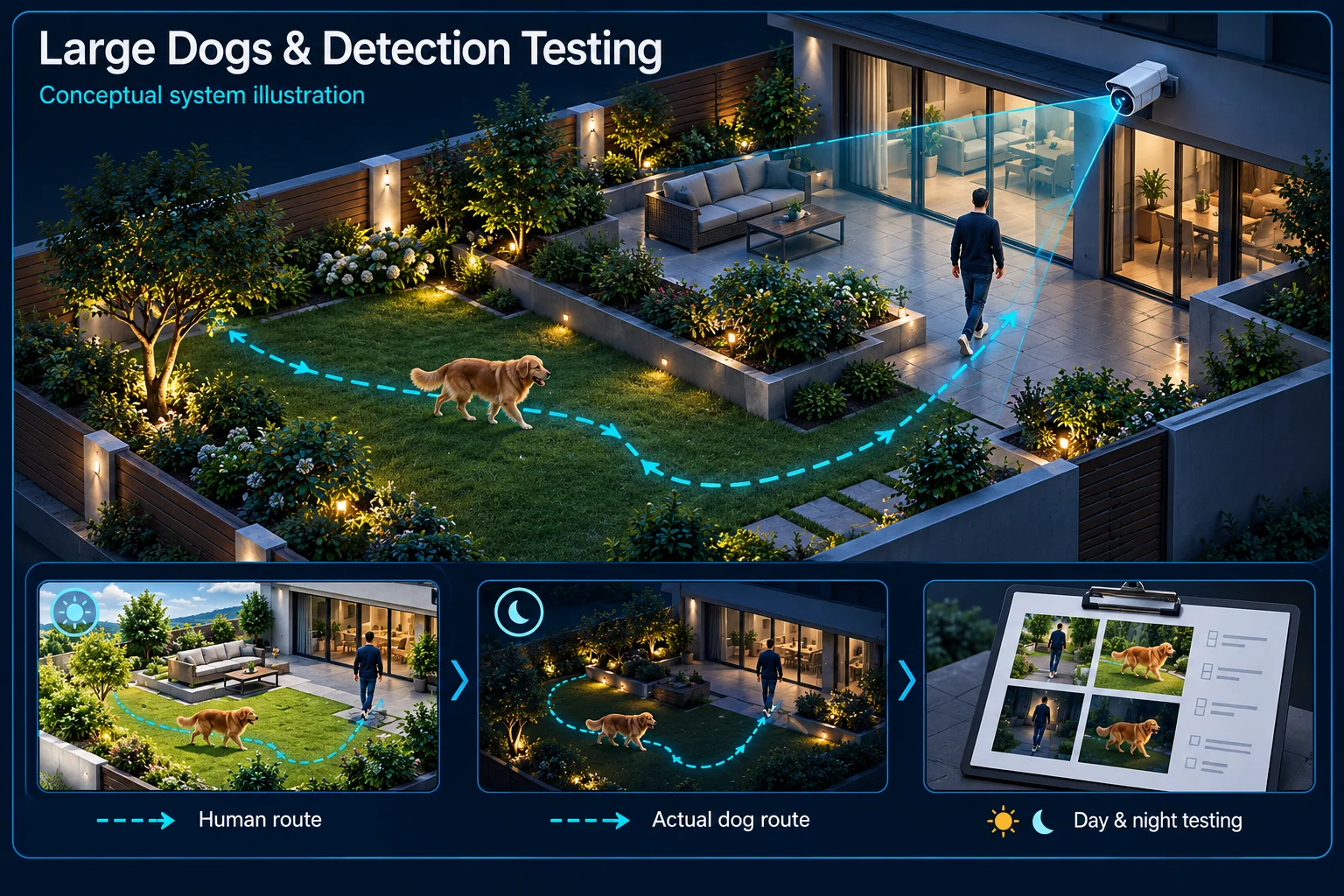
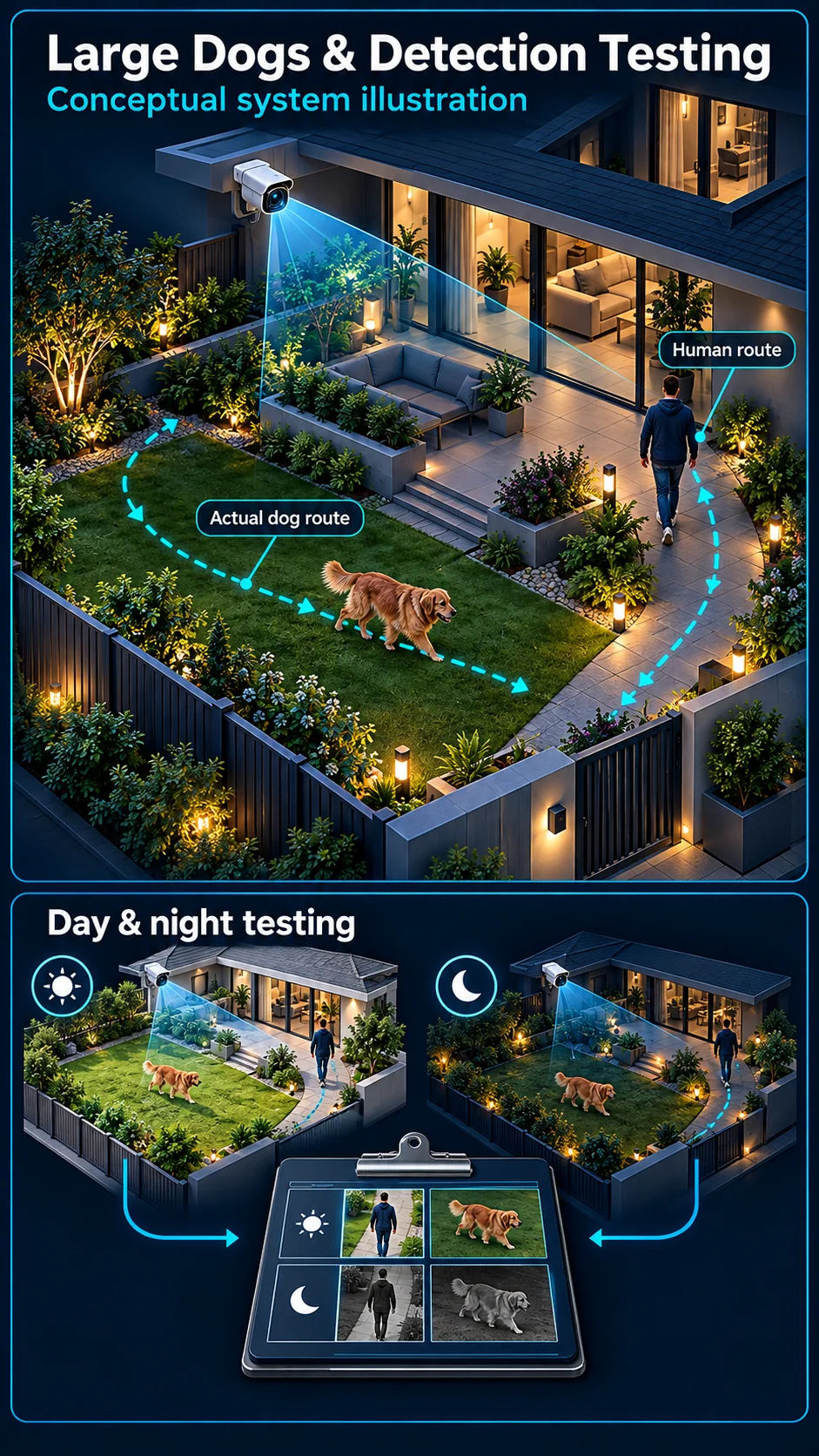
System planning notes
One garden, two test targets
The same view must be tested with a person and the actual dog. No animal-weight immunity or live AI analysis is represented.
Illustration: review person and dog routes under the property's representative daytime conditions.
Day test: Illustration: review person and dog routes under the property's representative daytime conditions.
Night test: Illustration: repeat relevant person and dog movement using the selected night mode and the agreed warning schedule.
- Solid line: illustrated functional path or agreed test route.
- Dashed line: optional device or compatibility to confirm.
- M1: Agreed view
- M2: Person test
- M3: Actual dog test
- A person test and a dog test are both required; no 40 kg exemption is implied.
- Routes and regions illustrate planning only, not a completed site acceptance test.
Intended detection must remain useful
Review unwanted events safely
Position, target filter and armed time
Clips and selected output checks
- E1: Person route → Chosen view and ruleIntended target test
- E2: Actual dog route → Chosen view and ruleAnimal behaviour test
- E3: Chosen view and rule → Day + night recordRecord both results
Separate two different meanings of pet immunity
Camera target classification is an image-based function
A supported human filter evaluates the camera image under its own rules and conditions. It does not weigh the animal. Dog size, posture, movement, occlusion and how the scene is presented to the camera can affect the event behaviour that needs to be tested.
PIR detector claims belong to that exact detector
An alarm detector's pet specification is a different product condition, not a camera classification result. Check the complete detector model and installation requirements independently. A lower pet-weight specification cannot be reused as proof that a 40 kg dog will be ignored.
Design the home around normal animal movement
Keep routine garden use distinct from an armed entrance
Map where the dog plays, jumps, rests or approaches the gate, and where people must be detected. Avoid treating every movement across the whole garden as a warning requirement. A supported boundary or region rule should reflect the actual security task.
Use at-home, away and night routines deliberately
Family activity with the dog differs from an unoccupied side entrance at night. Agree which rules and outputs apply in each mode, including how a user pauses and restores warnings. The camera must not be assumed to recognise familiar people or pets.
Test people and the actual dog
A quiet dog test is only half the question
Check that a person on the required route produces the intended event as well as reviewing unwanted dog-triggered events. A setting that suppresses all alerts is not acceptable evidence of useful protection. Use safe, controlled paths appropriate to the property.
Repeat under relevant daytime and night-time conditions
Review the intended approach directions, distances, lighting and normal dog activity. Include the areas where the animal and a person may overlap in the view. Record event clips and selected outputs rather than relying on a short live-view demonstration.
Agree what the handover establishes
Keep a practical acceptance checklist
Document the selected device, camera position, target filter, line or region, schedule and tested routes. Note examples of intended detections and nuisance events. The accepted result applies to that configuration and scene; it is not a general certification for all dogs of a certain weight.
Review changes to the garden or routine
New furniture, a raised platform, growing plants or a moved camera can alter the view. Reassess settings when relevant conditions change. Explain who may adjust rules and when HJ should review a problem, without guaranteeing a permanently fault-free or false-alarm-free installation.
Questions about Large Dogs & CCTV False Alarms
Will a 40 kg dog definitely never trigger the camera?
No such guarantee is made. The selected device, view, target rules and actual animal behaviour need site testing, including both daytime and night-time conditions.
Can I increase the threshold until the dog no longer triggers?
Any setting change must also preserve the intended detection of people. Test both conditions and review the actual device's supported controls; simply eliminating dog alerts is not sufficient acceptance.
Does a pet-immune alarm detector prove the CCTV will ignore pets?
No. An alarm detector's conditions and a camera's classification behaviour are separate. Each selected device needs its own evidence, installation review and relevant test.