System design
General CCTV Surveillance and Evidence Planning
General surveillance describes how useful camera views become an accessible record for a property operator. It is an architecture-level discussion, distinct from the Essential reference plan's equipment list. A design can use different connection methods and selected camera functions while keeping observation, storage, retrieval and response responsibilities clear.
How this architecture fits together
Surveillance & Evidence Planning Canvas
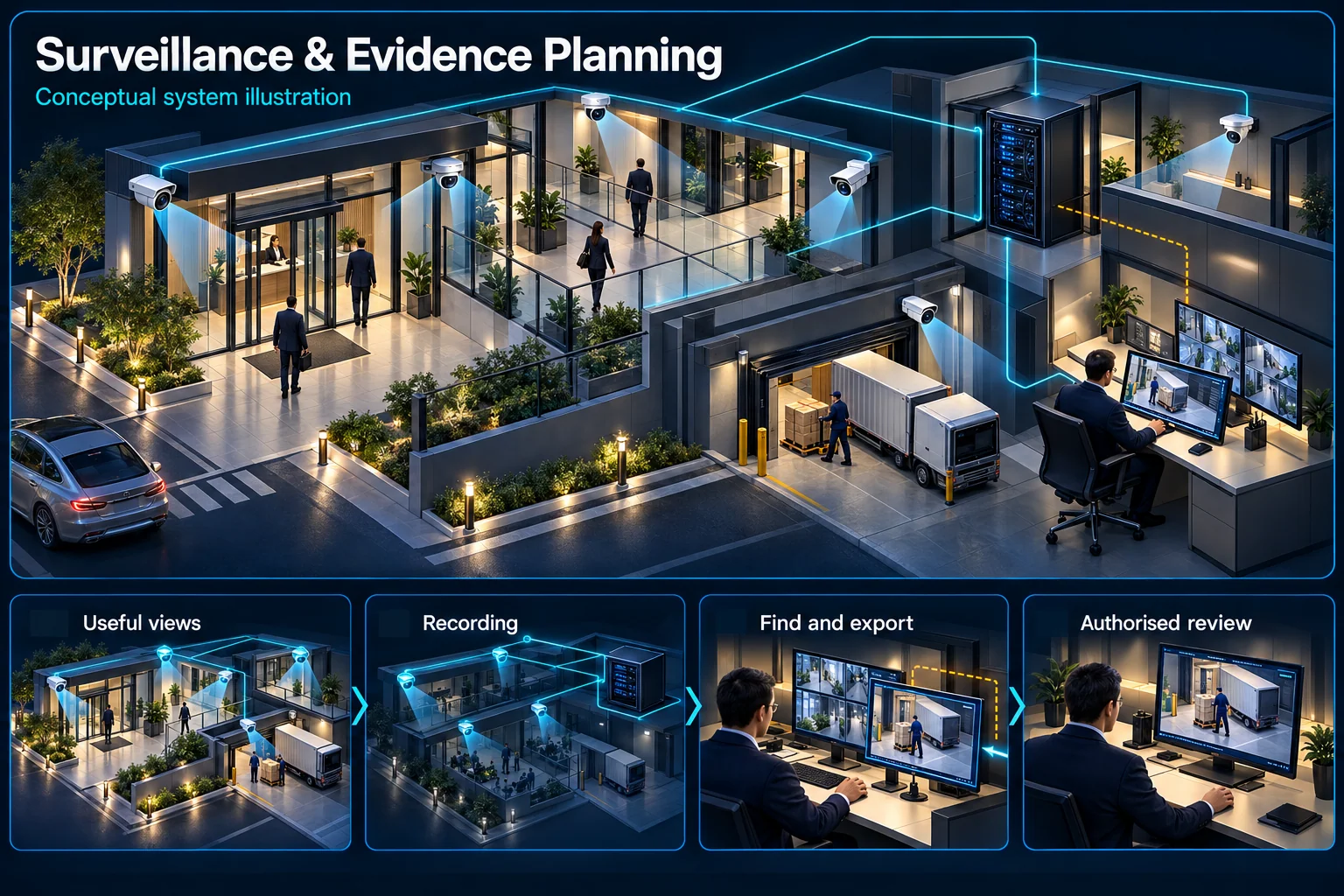
System planning notes
A surveillance architecture follows the evidence question
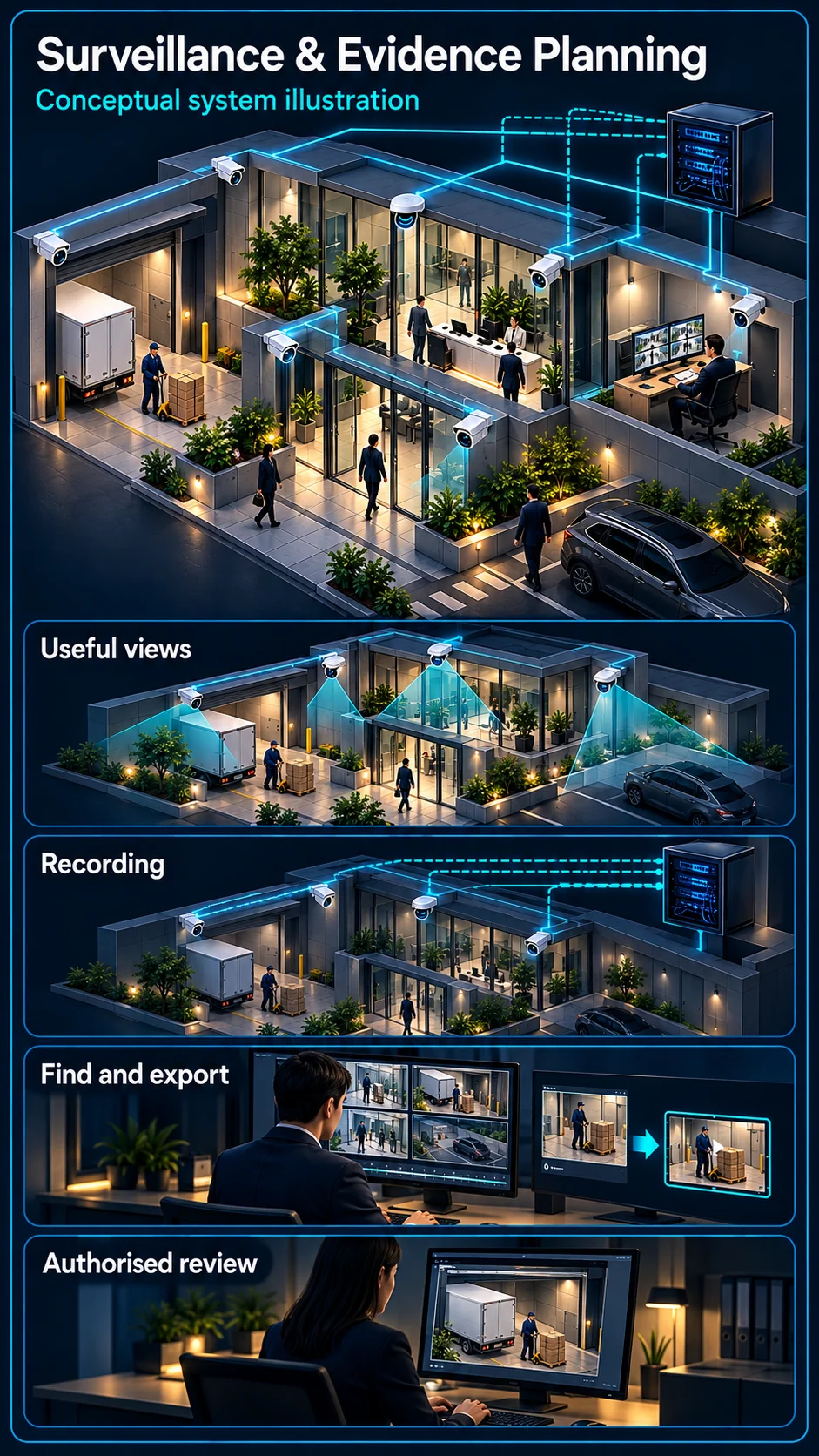
The illustration starts with a viewing purpose and finishes with an authorised, retrievable record.
- Solid line: illustrated functional path or agreed test route.
- Dashed line: optional device or compatibility to confirm.
- This is an operating architecture, not a fixed equipment package or guaranteed identification performance.
- No siren or alarm panel is added unless the approved response scope calls for it.
What must the operator understand?
Position, lighting and permitted coverage
Connection, streams and storage
Find the correct time and view
Named role and agreed procedure
- E1: Observation purpose → Planned camera viewsDefine the useful view
- E2: Planned camera views → Recording strategyPreserve activity
- E3: Recording strategy → Authorised retrievalFind and export
- E4: Authorised retrieval → Review and next actionEvidence-informed review
Begin with the question a view should answer
Overview and detail are different needs
A wide view may explain movement through a space while a more specific view supports review at an entrance or handover point. Position and lighting should follow the intended question. More pixels alone do not decide whether the right activity is visible.
Respect ordinary use and privacy
Agree permitted views and the people who need to use them. In a shared property, an observation requirement does not automatically authorise access to every tenant or private area. Keep camera placement aligned with the approved operational purpose.
Connect the views to a recording strategy
Choose a suitable connection architecture
Analogue, IP and Wi-Fi each introduce different transport and supply requirements. Select an architecture that fits the site and approved functions. None of these connection names alone establishes the quality of every view or all supported event analytics.
Plan evidence retention deliberately
Define when incidents may be discovered, who reviews them and whether clips must be exported. Storage, stream settings and recording schedules follow that need. A live camera feed without an agreed retrieval path is an incomplete evidence workflow.
Decide whether an active response is needed
Observation can remain a quiet function
Public circulation and working areas often need useful recording without an automatic siren. Quiet monitoring can be appropriate; warning outputs are assessed separately. Choose any target rules and notifications for the actual scene and operating hours.
Separate optional event-response layers
Camera warning, independent alarm control and platform escalation are additional functions to assess. Their interfaces, permissions and acceptance tests should be explicit. An architecture overview must not quietly turn those optional layers into included equipment.
Check the complete evidence workflow
Review real scenes under changing conditions
Inspect the agreed areas by day and night, including backlight, normal movement and relevant obstructions. Confirm names and timestamps. The acceptance task should reflect the purpose of each view rather than treating every camera position as interchangeable.
Give the operator a usable handover
Practise finding and exporting a clip with the correct access role. Record the chosen settings, equipment and support responsibilities. Explain what depends on internet access and what any agreed backup supply covers, so later changes can be assessed sensibly.
Questions about General Surveillance Architecture
Is general surveillance the same package as Essential?
No. General surveillance explains an architecture and operating purpose. Essential is a named recording-focused reference plan whose actual installed equipment is selected for the site.
Does this architecture need human detection?
Not in every view. The customer's problem determines whether target filtering or another event function is useful. Any selected analytics need exact equipment and configuration support.
Why test playback as well as the live picture?
A usable surveillance system must let the authorised user retrieve the required event, not merely display current activity. Recording, retention, permissions and export all affect that task.