System feature
180° & 360° CCTV: Overview Coverage and Useful Detail
A panoramic or fisheye view can help an operator understand a wider area, but overview coverage is not the same as identifying detail everywhere in that view. HJ considers the selected camera, mounting position, scene and playback workflow before using wide-angle coverage as part of a site plan.
How this feature fits together
180° & 360° CCTV Planning Canvas
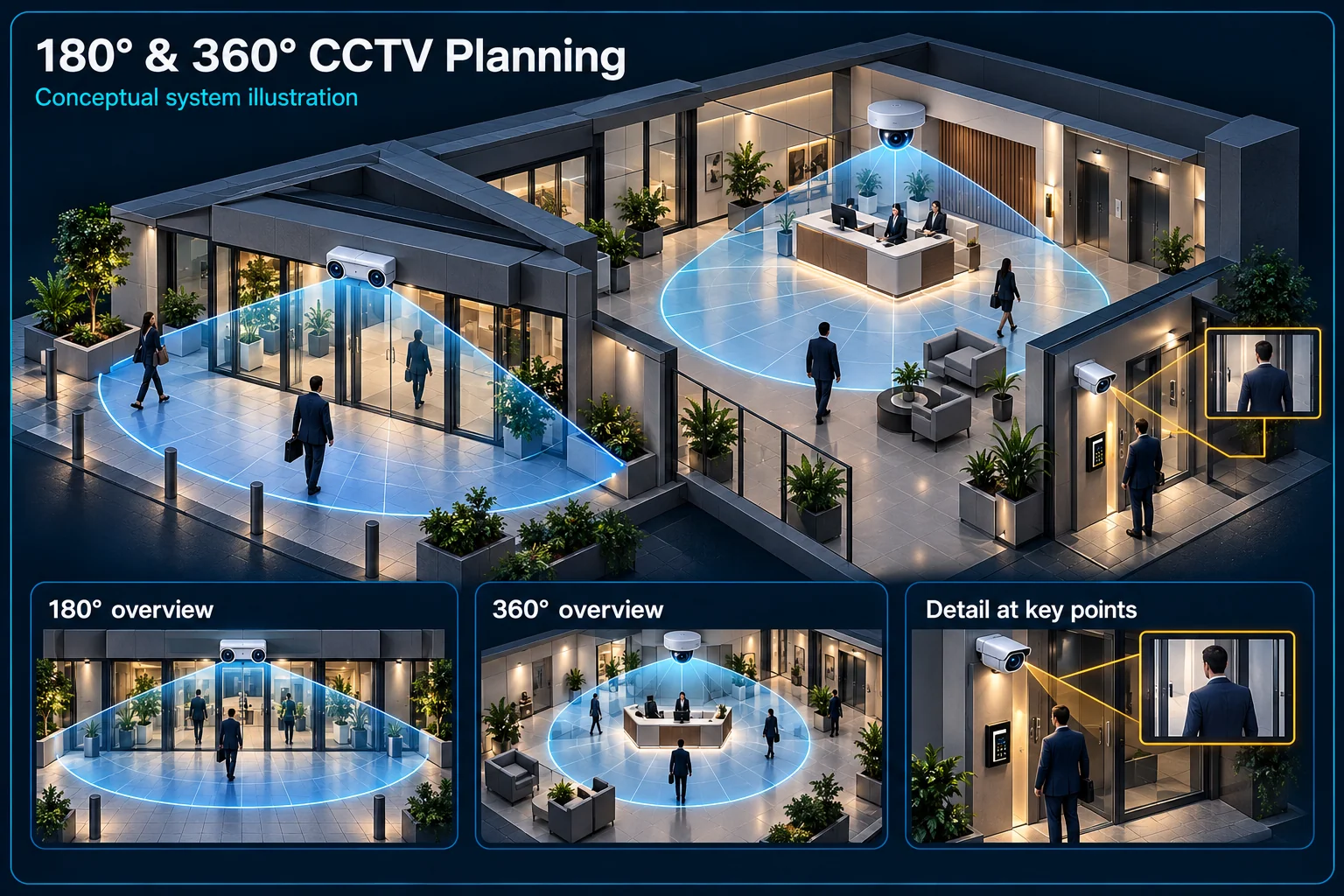
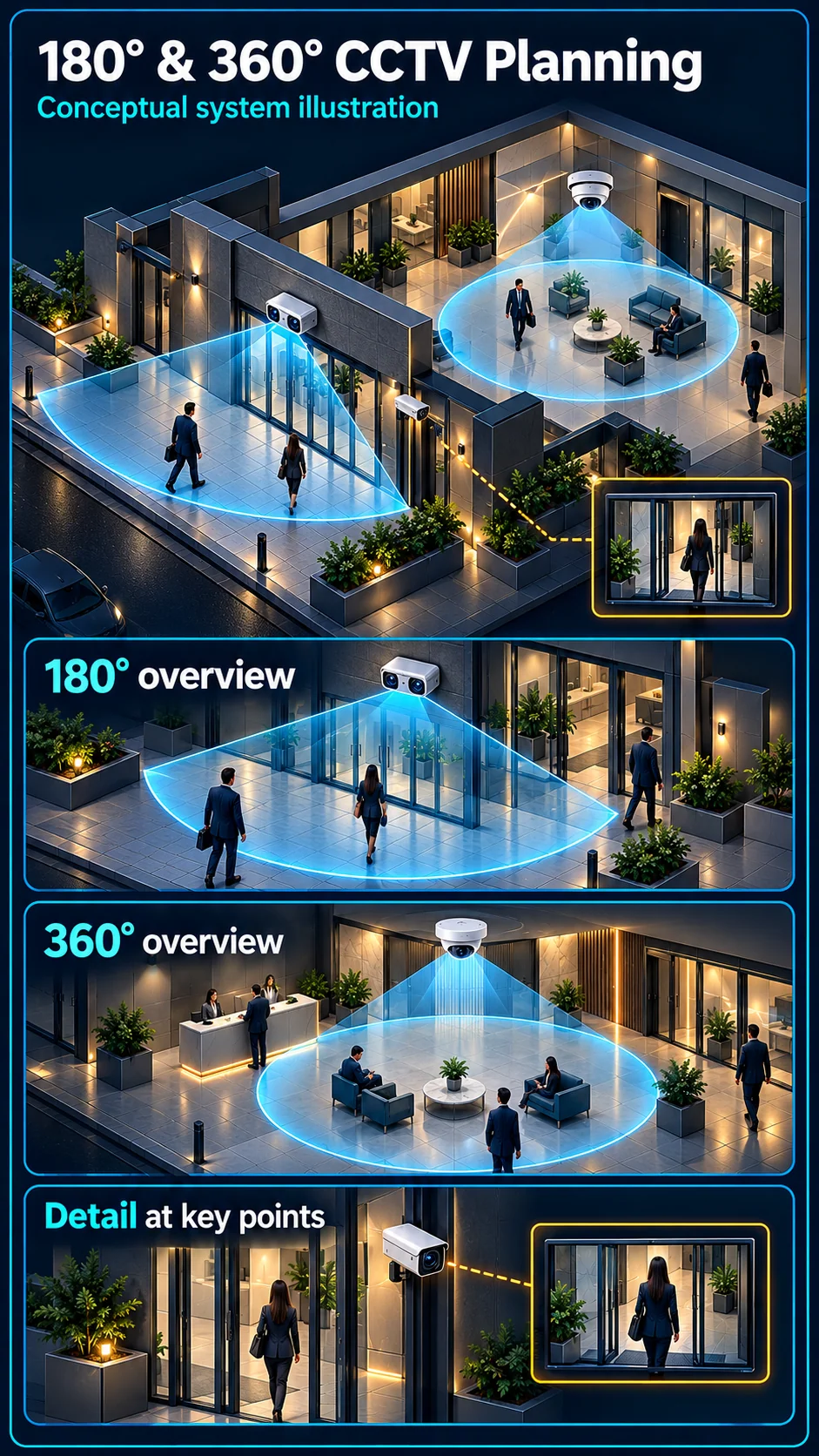
System planning notes
Wide overview and a detail target are different views
The half-circle and all-around concepts describe viewing layouts only. They are not measured optical or recognition performance.
- Solid line: illustrated functional path or agreed test route.
- Dashed line: optional device or compatibility to confirm.
- Wide coverage is not uniform recognition detail.
- Actual angles, display modes and evidence views depend on the selected equipment and site.
Broad view from a suitable position
All-around scene context
Review a face, till or doorway separately
Supported display, search and export
- E1: 180° concept → Critical detail targetCheck required detail
- E2: 360° concept → Critical detail targetCheck important positions
- E3: Critical detail target → Usable playbackVerify the recording workflow
Give the panoramic view a clear job
Use the overview to understand movement
A broad view may help review how people or vehicles moved through a suitable area. Start with that operational question and the boundaries that may be observed. A wide-angle label does not establish that every corner has the same useful level of detail.
Keep critical close-up tasks separate
An entrance, till or handover point may need a dedicated evidence view. Review the detail required at the actual target positions instead of assuming one overview replaces every closer camera. The camera count follows the task, not the appeal of a single large picture.
Check mounting and presentation
The installation position changes the useful scene
Ceiling height, wall position, obstructions and the direction of important activity affect what can be observed. Check the selected camera's intended mounting and image modes. This planning diagram is a geometric illustration, not a measured field-of-view or recognition-distance claim.
Fisheye display and dewarping need review
Where the chosen camera and platform support it, an overview can be presented through suitable views or dewarping. Confirm the live and playback experience on the actual recorder, client or app. Do not assume every receiving platform offers the same display controls.
Keep other capabilities model-specific
A broad image does not establish every analytic rule
Human filtering, line crossing, intrusion or tracking require their own supported functions and operating conditions. Confirm the relevant view or channel behaviour for the selected camera and receiver. Panoramic coverage alone is not evidence that every region can run every rule simultaneously.
Audio, lighting and storage still need a scope
Review whether the selected device includes appropriate microphones, illumination or warning outputs, and how its streams are recorded. A wide-angle family name does not include those functions automatically. Include the intended recorded views and retention profile in the system design.
Verify how an operator will use the footage
Test the important positions, not only the centre
Review representative targets across the agreed scene, including edge areas, obstructions and relevant night lighting. Compare the useful overview and any required detail views. Keep the accepted positions and observed limitations as part of the view record.
Search, replay and export the required view
Demonstrate finding a relevant moment and using the supported playback controls. Confirm what an exported clip contains and how an authorised recipient will view it. A visually impressive live panorama is not enough if the required recorded evidence cannot be retrieved usefully.
Questions about 180° & 360° Panoramic CCTV Planning
Can one 360° camera remove every blind spot?
Do not assume that. Mounting, obstructions and the evidence task still matter. Review actual coverage and detail at the required positions before deciding which other views can be omitted.
Does 180° coverage identify a person across the entire image?
The angle alone does not establish recognition detail. Evaluate the selected camera, lens arrangement, target positions and recording settings against the agreed review task.
Can every app dewarp a fisheye recording?
No universal display capability is implied. Confirm support and demonstrate the live, playback and export workflow on the actual platform selected for the installation.